Efficiently processing your paper mail can lead to a lot of great benefits. It will help simplify your life, and minimize the amount of physical objects in your living space.
It’s a seemingly simple task, but for some reason, I still see people letting the pile stack up high. I don’t know about you, but those piles absolutely stress me out.
They’re ugly, they usually fall over– making a mess, and your subconscious is constantly reminded that you need to go through it every time you walk past it on your kitchen counter. All of these elements create a minor amount of stress in your life that can easily be removed.
If you’re anything like me, when you first started adulting you probably checked your mail infrequently, and had a good size pile yourself. This post outlines the process that I have developed and use to conquer this paper enemy.
1. Check your mail twice a week
The best way to prevent a large pile of mail is to not let it accumulate in the first place. On the other hand, you don’t want to constantly be traveling to the mailbox.
My mailbox is a locked box that is in a shared unit in my development. It takes about 10 minutes to walk to and from the mailbox, so I’ve found checking it twice a week minimizes my travel time, but also allows enough mail to accumulate where it’s just right (shameless Goldilock’s reference). So if you’re in an apartment complex or have a mailbox area in your development– I think this is the best cadence.
If you have a mailbox right outside your house, you can of course check it more frequently.
2. Go through it right away
After you get your mail, set it down on your dining table, and mentally tell yourself that you’re going to go through the whole pile before moving on to another task.
This will get easier over time as you reinforce the habit each time you process your mail.
3. Triage
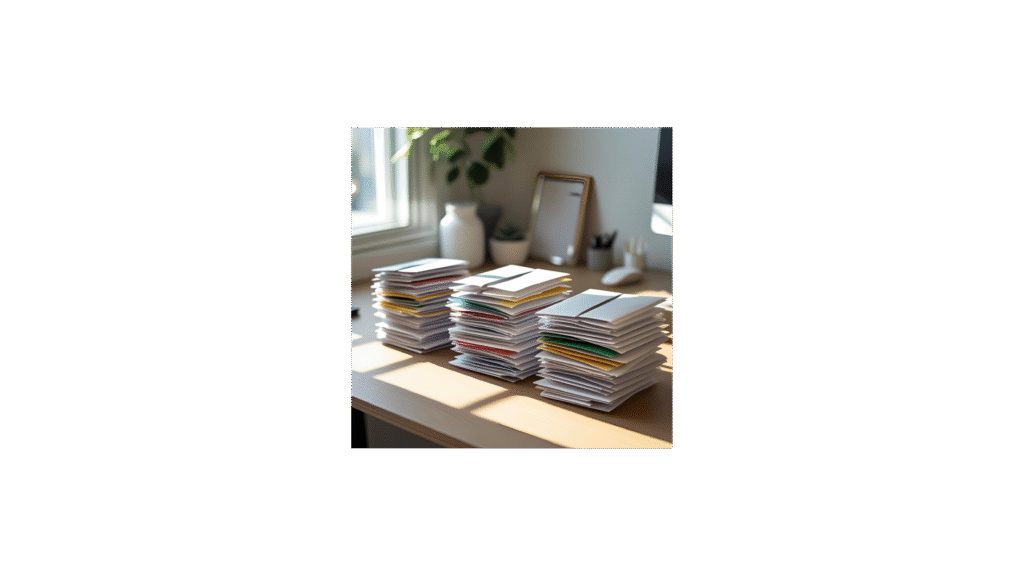
The first thing you’re going to do is sort the mail into three piles. Those three piles are “Action Items”, “Shred/Burn”, and “Recycling”.
Pick-up/open the piece of mail to identify it. Place each piece of mail into one of three piles (based on which category the piece of mail is). Here are the definitions for each category:
Recycling: These are pieces of mail that don’t require you to do anything, and don’t contain any sensitive information. Examples would be coupon sheets and advertisements.
The key piece here is to not throw them away, but put them into your recycling bin. If you have a small business where you ship and package– use these as free packing material.
Shred/Burn: These are pieces of mail that don’t require you to do anything– but they contain “sensitive” information that you aren’t comfortable putting in your recycling bin due to the fear of someone gaining access to said information.
The definition of “sensitive” is of course subjective. For me, common pieces of Shred/Burn mail are credit card offers and other targeted offers that contain information such as my name or account information.
Action Items: These are pieces of mail that require you to do something/are a reminder to do something. Examples of action items would be a bill that you need to pay, a credit card that you need to activate, a tax document that you need to file, or a birthday card with some money in it (you’ll need to put the money in your wallet, and write a thank you card).
Another quick tip is to immediately put envelopes/other junk material that was in the same envelope as a Shred/Burn or Action Item into the Recycling pile.
4. Process the piles
Start with the easiest pile: Recycling. Immediately after finishing the pile, put it all directly into your recycling bin. To be clear, this should be the recycling bin in your garage/outside that goes to the curb on trash day.
It’s important to put it directly there, so that you avoid an unnecessary intermediate step of staging the material, and so that the pile is visually out of your sight as you live in your home. Remember that our brains subconsciously process everything in our visual frame– and we want to create minimalist environments for ourselves.
Note if you receive any packages, put the packaging material directly into the recycling bin as well.
Next, tackle the second easiest pile: Shred/Burn. Your one time set-up step before you can process this pile, is to create a designated container to put these pieces of mail before they are shredded or burned. This should be a container that you can put the mail into, which is also out of sight. I recommend using a drawer that is inside a closet in your office (out of sight), or even a box that you keep in your garage (out of sight).
Once your container exists, simply put your Shred/Burn pile into the container. I personally use a shredder, and it can be a bit of a hassle to get out (I keep it stored away) and setup– so I typically shred once every 2-3 months.
Finally the most complex pile: Action Items. If the action you need to perform takes less than five minutes (for example activating your credit card or filing a tax document into your tax folder)– do it immediately.
You’ll find that the majority of Action Items do in fact take less than five minutes and your brain will experience a sense of achievement in quickly conquering these easy tasks. The approach for tackling the 5+ minute items depends on the quantity that you have. Recall that with this process you are reviewing your mail every 3-4 days, so it should be uncommon that you ever have more than 1-2 of these 5+ minute items.
If you only have 1-2 of these items, and you’re feeling motivated– tackle them immediately– but listen to yourself and don’t push it if they’re not urgent items that need to be done right away.
If you have more than 1-2, consider doing one per day. The items that you don’t do on the day of getting your mail, should be added to a to-do list so that they don’t get lost in the shuffle. I keep a shared to-do list on Apple Notes.
5. Future proof
One of the best ways to reduce the amount of mail you receive is to go paperless as much as possible. If you receive statements or records of bills (that don’t require payment and are strictly an FYI) that you never look at– consider switching to paperless.
You’ll have less mail to go through, and will help the planet.
Unsubscribe to any services that are sending you material that you don’t want.
6. Pat yourself on the back
You’re staying on top of your responsibilities. You’ll find this process getting easier and easier each time you do it as well as shorter. Eventually, this whole process will take you less than 3-5 minutes typically.
Enjoy the fact that you’ve made a part of your life easier and simpler!